
Types of Sheet Metal Storage Racks
Manufacturers and fabricators with poor sheet metal storage can face safety risks, bottlenecks and wasted floor space. The right storage system can reduce these problems by matching rack design to operational reality.
While customized options are available, six primary sheet metal storage racks exist, each with distinct trade-offs in capacity, accessibility, safety and floor space requirements. The optimal system type depends on the facility’s logistics and production needs.
1. Vertical Sheet Metal Racks
These racks store metal sheets upright in slotted or divided frames. Sheets are accessed by hand when safe to do so, or with a light forklift for heavier materials. This configuration suits smaller fabrication shops, facilities with moderate retrieval volume and single-operator workflows.
Advantages
The main advantages of these racks include:
- Capacity range: Configurations can often accommodate numerous sheets per unit, depending on rack design, sheet dimensions and material weight.
- Individual sheet visibility: Upright positioning provides direct line-of-sight access to each sheet. Operators can identify and retrieve materials without disturbing inventory.
- Reduced floor stacking: Vertical orientation helps eliminate floor-level sheet piles. This supports safer material storage practices consistent with OSHA 1910.176 and reduces potential trip hazards.
- Compact footprint: Vertical sheet metal storage delivers high sheet count per square foot, favorable for shops with limited floor area.
Disadvantages
Vertical sheet metal storage doesn’t fully utilize extreme ceiling heights as effectively as automated vertical systems. Manual handling limitations also cap the sheet weight and size stored safely. While great for manual access, forklift loading can be awkward depending on rack design.
2. Horizontal Sheet Metal Storage Racks
These metal sheet storage racks keep materials flat on horizontal shelves or roll-out levels. Sheet weight is distributed across the full surface of the rack. Horizontal sheet metal storage suits fabricators handling full-size, heavy-gauge sheets or high-volume operations where full-pallet retrieval is standard.
This configuration supports improved warehouse storage efficiency through bulk material handling.
Advantages
The advantages of horizontal sheet metal rack systems include:
- Superior capacity for full-size sheets: Heavy-gauge materials can lie flat without edge stress, reducing the risk of warping during storage.
- Strong forklift and crane compatibility: Flat orientation helps operators retrieve sheets without maneuvering upright materials.
- Stable storage without tripping risks: Sheets remain secured at the shelf level, aligning with OSHA material handling guidelines and reducing floor hazards.
- Efficient pallet-load retrieval: Facilities retrieving sheets in full pallet loads benefit from faster access times.
Disadvantages
Horizontal sheet metal storage racks require wider aisles for forklift maneuvering, which uses up floor space. This storage type may not suit high-mix, low-volume manufacturers who need frequent access to different materials. Storage density may result in fewer sheets stored per square foot compared to drawer-based or vertical systems.
3. Cantilever Racks
These sheet metal storage racks consist of open-front systems with horizontal arms extending from vertical columns. Cantilever racks don’t have front uprights that obstruct access, making them effective for mixed storage needs. Cantilever suits metal service centers, distribution operations and forklift- or crane-based facilities.
Advantages
These racks suit facilities with mixed or irregular profiles due to their:
- High load capacity: Heavy-duty adjustable arm configurations support single and double-sided storage options for varying sheet lengths and weights.
- Accessible open front: Forklifts can access materials from any angle without navigating uprights, improving retrieval efficiency.
- Arm overload prevention: Proper arm spacing and load ratings specified in the ANSI MH16.3 cantilever rack standard reduce the risk of structural failure.
- High storage density per aisle: Double-sided configurations maximize material capacity within the rack’s immediate footprint, effectively utilizing linear space in facilities with adequate aisle width.
Disadvantages
Cantilever racks require wide aisles to accommodate forklift turning radius. Aisle widths often span several feet, depending on forklift type, load size and facility layout, making this one of the higher floor space demands among metal rack systems. These racks aren’t suited for single-operator manual retrieval, as forklift dependency is essential for safe access to materials.
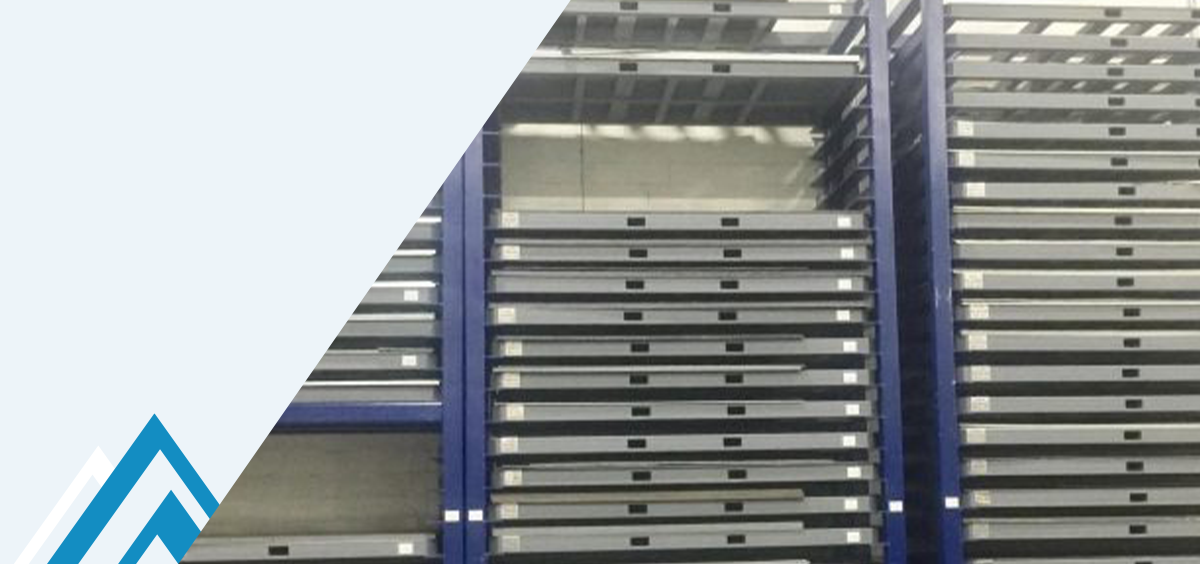
4. Drawer-Based Sheet Metal Storage Racks
These are vertical tower frameworks with roll-out drawer trays. Each drawer holds a dedicated sheet layer independently. Drawer-based storage racks suit operations handling high-value, surface-sensitive materials like stainless steel and aluminum, where scratch prevention is critical.
Advantages
Heavy-duty configurations may support per-drawer loads weighing thousands of pounds, depending on system design and manufacturer specifications. They fully extend, enabling access to individual layers and supporting inventory control without disturbing adjacent sheets. Operators can retrieve sheets independently, and hand-crank mechanisms are available for heavier loads.
This design reduces forklift traffic while supporting safer material handling practices, consistent with OSHA’s general storage and handling guidance.
Disadvantages
Drawer-based sheet metal storage racks are fixed once installed and aren’t easy to relocate. Mismatched drawer sizes reduce capacity, so careful planning is crucial. These racks also involve more complex installation and higher up-front costs than standard systems.
5. Mobile Sheet Metal Storage Systems
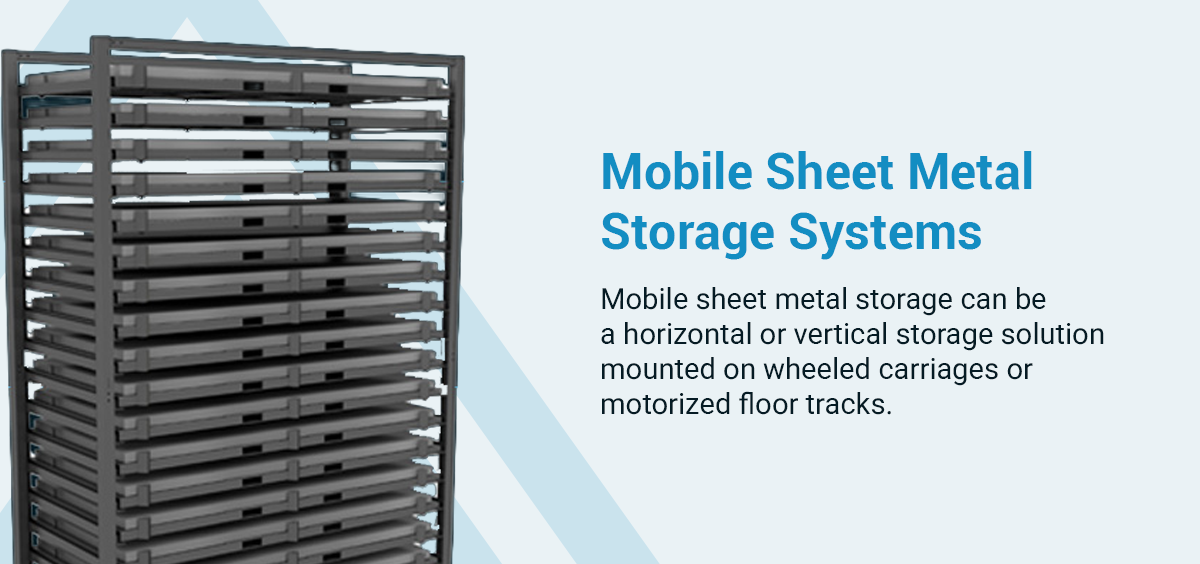
Mobile sheet metal storage can be a horizontal or vertical storage solution mounted on wheeled carriages or motorized floor tracks. Racks compact when not in use and open to create a single accessible aisle as needed. These storage systems suit facilities with moderate retrieval frequency where floor space efficiency is a priority.
Advantages
Key advantages of mobile storage systems include:
- Floor space optimization: Eliminating fixed aisles allows facilities to achieve full storage capacity in less floor area.
- Capacity retention: This option retains the full capacity of the underlying rack system while adding space efficiency.
- Full rack accessibility: When the aisle opens, the retrieval process is comparable to that on static racks, with complete visibility.
- Safety mechanisms: Locking systems hold racks securely during access, and controlled aisle opening eliminates trip hazards.
Disadvantages
Only one aisle position is accessible at a time with mobile systems. This limitation can make them unsuitable for operations that need simultaneous multi-position access or high retrieval rates. Facilities also need reinforced flooring to support track systems and loaded rack movement, which may require facility modifications.
Mobile sheet metal storage also comes with higher up-front costs than static racks, and motorized systems require periodic maintenance.
6. Automated Sheet Metal Storage
Computer-controlled vertical lift modules or tower systems automatically retrieve sheet trays and deliver them to ground level. The automation will respond to an operator’s command. This type suits high-volume fabrication operations with frequent, rapid-retrieval demands and facilities that run multiple shifts or continuous production.
Advantages
Automated storage and retrieval systems (ASRS) offer many advantages, including:
- Storage density: Systems can provide up to 10 times more storage locations than standard racking in the same footprint.
- Single-operator retrieval: Operators retrieve materials at ergonomic ground level with no forklift certification required.
- System integration: Direct integration with enterprise resource planning (ERP) and warehouse management system (WMS) platforms enables real-time inventory visibility and automated stock tracking.
- Reduced forklift traffic: Automated access eliminates most forklift movement in storage areas, reducing collision risks.
- Vertical space utilization: A vertical storage carousel uses height rather than floor area, making it suitable for facilities with limited horizontal space.
Disadvantages
Automated systems represent the highest initial investment among the six rack types due to their installation complexity and software integration. They require ceiling-height clearance for vertical towers, so they’re not suited to low-ceiling facilities. Fixed installation can also make reconfiguration difficult.
When Custom Sheet Metal Storage Is the Right Choice
Custom solutions may be necessary when off-the-shelf configurations can’t accommodate specific requirements. They may be the right call when:
- Sheet sizes exceed standard rack dimensions.
- Load weights surpass typical ratings on standard facility layouts.
- Ceiling heights limit options.
- Production workflows require specialized access configurations.
Summit Storage’s in-house engineers provide custom rack solutions for specific requirements, rather than forcing standard systems to fit unusual operations.
Custom Sheet Metal Storage Systems Made in the USA
Once you’ve identified your preferred rack type, the next step is finding a manufacturer who can build it to spec. Summit Storage designs and builds custom racks and vertical storage carousels. Our sheet metal storage systems are manufactured in the USA and engineered to your specific material sizes, retrieval demands, production volumes and facility layouts.
Every system will receive individualized attention, full customization and dedicated installation support. Request a quote to discuss how we can fulfill your storage requirements.